On This Page
Overview: Solar Incentives in Queensland
Solar power rebates in Queensland remain one of the biggest reasons households and businesses continue to adopt rooftop solar. With abundant sunshine, supportive federal policies and rising energy prices from energy companies, Queensland is consistently ranked among Australia’s top solar states.
If you’re researching solar rebates in Queensland, it’s important to understand that savings usually come from a combination of programs rather than one single rebate. The three main rebates Queensland homeowners are eligible for include:
- The Federal Government Small-scale Renewable Energy Scheme (SRES)
- The Cheaper Home Batteries Program
- Ongoing savings via Feed-In Tariffs (Solar Credits)
This guide explains every major solar power rebate Queensland homeowners can access in 2026, how they work, eligibility requirements and how to maximise your return on investment.
1. Small-scale Renewable Energy Scheme (SRES) – Federal Solar Rebate
What Is the SRES?
The Small-scale Renewable Energy Scheme is the primary government solar rebate Queensland households rely on. Although it’s a federal program, it applies fully in Queensland and significantly reduces the upfront cost of installing solar PV systems.
The scheme supports systems up to 100 kW, though most homes install between 6.6kW and 30kW.
How the Solar Power Rebate QLD Works
When you install solar, your system generates Small-scale Technology Certificates (STCs). These certificates have a market value and are usually applied as an instant discount on your solar quote.
The number of STCs depends on:
- System size (kW)
- Installation location (Queensland earns more STCs due to high solar output)
- Year of installation (rebate value reduces each year until 2030 when the rebate ends)
Your solar installer typically handles the paperwork, making this solar rebate QLD simple and hassle-free. When considering solar installers, ensure you book with a company who provides a detailed explanation of what rebates you are eligible for and how the rebate will be applied to your solar system.
Queensland STC Savings On System Size
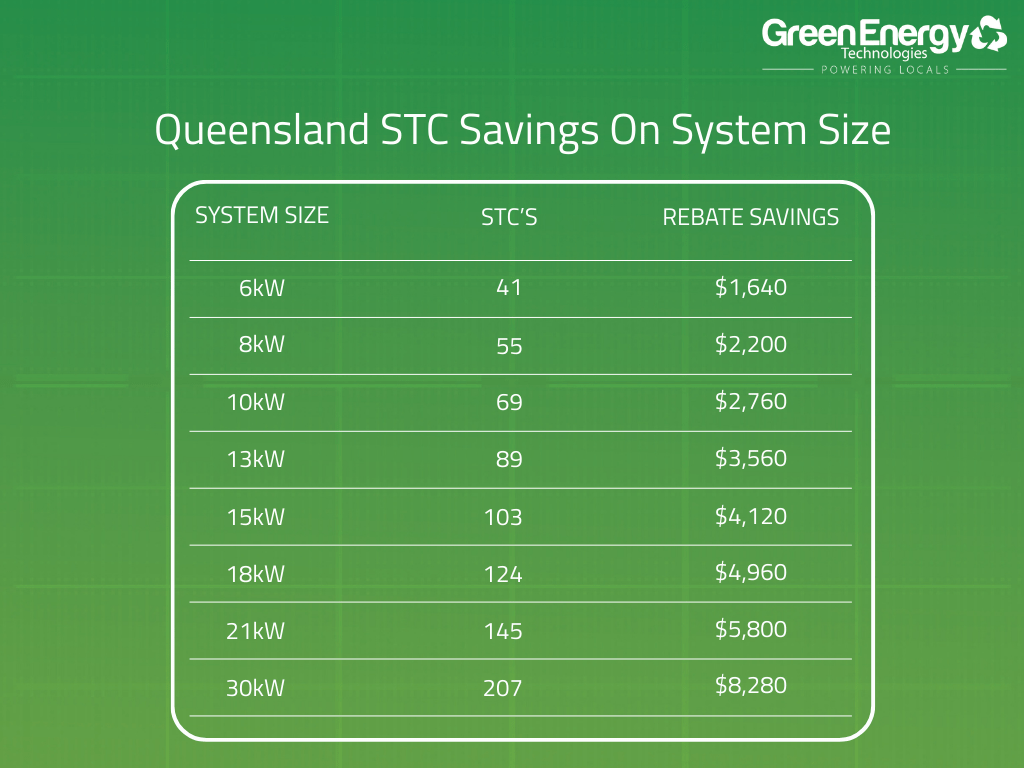
This table is based off the average monetary value of a STC, which fluctuates on the open market. The current value is $40 but can vary between $36-$40.
Eligibility Criteria for STC Solar Rebate
To qualify for the solar power rebate Queensland there are a few main eligibility requirements:
- All solar products must be on the Clean Energy Council (CEC) approved PV list
- Installation must be completed by a SAA-accredited installer like Green Energy Technologies
- System must be installed within 1 year of the STC’s being created
Key advantage: This rebate is not means-tested, making it accessible to homeowners, landlords, and businesses alike with solar systems sized up to 100kW qualifying for the rebate.
2. Cheaper Home Batteries Program
What is the Cheaper Home Batteries Program?
Introduced in July 2025 The Cheaper Home Batteries Program was introduced to offset the costs of installing solar batteries. Due to it’s immense popularity within the first 6 months of the programs’ release, amendments have been made to the available rebate amounts.
How the Battery Rebate Works
Under the Cheaper Home Batteries Program, your battery system qualifies for a rebate based on its usable kilowatt-hour (kWh) capacity. Installers typically apply this as a discount directly to your solar battery purchase at the point of sale, so the savings are realised upfront on the invoice rather than as a later cash rebate.
Originally the rebate value was relatively stable and higher; however, new changes implemented at the beginning of the year now mean:
The battery rebates decline every six months instead of yearly.
A tiered rebate system (STC Factor) reduces the proportion of the rebate available for larger batteries:
• 1–14 kWh: 100 % of rebate eligibility
• 14–28 kWh: 60 % of rebate eligibility
• 28–50 kWh: 15 % of rebate eligibility
Meaning the larger system incentives are sharply reduced to stretch funding and limit early exhaustion of the program’s budget.
A complete guide to the way the battery rebate works can be found here: The Solar Battery Rebate QLD Guide.
Battery Rebate Calculator
Given the complexity of calculating the discount solar batteries qualify for, we’ve developed a rebate calculator which factos in the battery size, the current STC rate based on installation date and the STC factor which determines the percentage of discount applicable.
You can find our free battery rebate calculator here: Solar Battery Rebate Calculator.
Eligibility Criteria for Battery Rebate
To qualify for the Cheaper Home Batteries Program rebate:
Battery Requirements
Must be a new battery system with nominal capacity between 5 kWh and 100 kWh
Only the first 50 kWh of usable capacity is eligible for the rebate
The battery and associated inverter must be on the Clean Energy Council (CEC) approved products list
Installation Requirements
The battery must be installed by an installer who is certified and accredited with the Solar Accreditation Australia (SAA) like Green Energy Technologies Installers
Additional Criteria
- Only one battery rebate is allowed per address
- On-grid systems must be Virtual Power Plant capable (VPP)
Key Takeaway
The Cheaper Home Batteries Program functions much like the Solar STC program in that it works off a rebate calculated by multiplying STCs, however additional factors, like more rapid decline and penalisations of larger systems make the Battery Rebate the more time-pressing rebate, with reductions in discounts happening more often and more steeply.
3. Supercharged Solar for Renters
What is the Supercharged Solar for Renters Program
The Supercharged Solar for Renters Program is a Queensland Government initiative designed to help Queensland renters benefit from solar energy savings by providing rebates to landlords for installing rooftop solar PV systems on rental properties. It aims to address the traditional “split incentive” in the rental market — where landlords pay for the solar system but tenants receive most of the bill savings — by giving landlords a financial incentive to make that investment.
How the Solar for Renters Rebate Works
The Supercharged Solar for Renters rebate works by providing landlords with a cash rebate based on the size of the solar system installed on their rental property. Although renters benefit through lower electricity costs, landlords must apply for and receive conditional approval before installation to be eligible.
Under the program, landlords can receive a rebate of up to $3,500 when they install an eligible solar system on a rental property.
The rebate is tiered by system size:
3.0–3.99 kW systems — up to $2,500
4.0–4.99 kW systems — up to $3,000
5.0 kW or more — up to $3,500
Larger solar systems can still be installed, but only the first 5kW qualify for the renters rebate.
Eligibility Requirements for the Solar for Renters Program
To qualify for the Supercharged Solar for Renters rebate several requirements for both landlords, properties and renter’s lease agreements must be met:
Landlord requirements
Must be an Australian resident and own the rental property.
The property must be located in Queensland and currently rented with an existing lease under $1,000 a week.
Property Requirements
- The property must be a Class 1a residential building (house, duplex, townhouse) or a secondary dwelling.
- No existing solar system should be installed on the property.
Lease Requirements
A valid rental agreement must be in place at the time of installation.
Some documentation regarding how solar generation will be treated (bill savings, rent arrangements) may need formal agreement.
For a full breakdown of eligibility requirements and how best to navigate applying for the Solar for Renters Program, see our breakdown here: The Supercharged Solar for Renters Program.
Key Takeaway
A long awaited solar incentive designed to make solar systems accessible for Queensland renters, this program relies on the cooperation of both landlord and tenant and requires specific conditions to be met with ongoing lease agreements.
4. Solar Feed-In Tariffs (FiTs)
What are Solar Feed-in Tariffs
Solar feed-in tariffs (FiTs) are payments made to solar system owners for excess electricity exported back to the grid. In Queensland, feed-in tariffs are not government rebates; instead, they are offered and paid by electricity retailers as part of specific energy plans.
Feed-in tariffs provide an ongoing financial benefit on top of upfront solar incentives such as the federal solar rebate. While they don’t reduce installation costs directly, they help lower electricity bills over time by crediting exported solar energy.
Queensland previously offered very high government-backed feed-in tariffs under the Solar Bonus Scheme, but this program is now closed to new applicants. Today’s feed-in tariffs operate in a competitive retail market, with rates varying significantly between providers.
How Do Solar Feed-in Tariffs Work
When your solar system produces more electricity than your home or business is using, the excess energy is automatically exported to the electricity grid. Your retailer then pays you a per-kilowatt-hour (kWh) credit for that exported power.
Typical Feed-in Tariff Rates in Queensland (2024–2025)
Approximately 5–12 cents per kWh
Rates vary by:
Retailer
Electricity plan
Time of export (some offer time-based FiTs)
North Queensland homeowners have fewer energy retailer options to choose from, often having only one option for connecting to the power grid, meaning the feed-in tariff isn’t negotiable.
Homeowners in the Mackay, Whitsundays and Townsville regions rely on Ergon Energy to supply their grid power which as of the 1st of July 2025 dropped their solar feed-in tariff from $0.12c per kW to $0.08c for every kW exported back to the grid.
Eligibility Requirements for Solar Credits
To receive solar feed-in tariffs in Queensland, you must meet the following general requirements:
System Requirements
A grid-connected solar PV system
System installed according to Australian standards
Retailer and Account Requirements
An active electricity account with a retailer offering a feed-in tariff
Some plans may require export limits or controlled inverter settings
Additional Notes
The Legacy Solar Bonus Scheme customers may still receive higher rates if eligible, but new systems cannot access these tariffs
Key Takeaways
Feed-in tariffs provide long-term bill savings, not upfront discounts
Rates can vary widely between energy retailers
Rates can change with minimial notice, for example the rate drop from $0.12 cent per kW to $0.08 cent per kW Ergon implemented in July 2025.
When used alongside solar rebates and smart energy usage, feed-in tariffs remain an important part of the overall Queensland solar savings equation however set pricing cannot be guaranteed long-term.
Maximising Solar Rebates In Queensland
In 2026, solar rebates in Queensland continue to make rooftop solar a smart financial decision. While the main savings come from the federal STC Scheme, combining this with competitive feed-in tariffs, the Solar Battery Rebate and interest-free financing options, 2026 is the best time for installing solar in Queensland.
Staying informed about changing Queensland solar incentives ensures you don’t miss out on thousands of dollars in potential savings. Whether you’re a homeowner, landlord, or business owner, solar remains one of the most reliable energy investments in the state.
If you’re looking to see what a solar solution could look like for your property and want to get an idea of the rebates you’re entitled to, contact our team of solar experts to discuss your energy needs.